ARTICLE
The Connected Neighbourhood
Mark Thurman
Last updated:
August 18, 2026

ARTICLE
The Connected Neighbourhood
Mark Thurman
Last updated:
August 18, 2026
An interactive 3D showcase — and why this is now an achievable business asset
I have been meaning to build a proper showreel piece for a while — something a prospect could actually use, rather than a flat screenshot of "work we've done". So I built one. It's an interactive 3D model of a UK neighbourhood designed around sustainable travel, it runs live in your browser, and you can explore it here.
Drag to orbit the streets, tap a marker to fly to the cycle route or the station, and drag the slider at the bottom to watch the traffic thin out and the carbon figure drop as the neighbourhood shifts away from private cars. It works on a phone. It's a single file.
This post is less about the demo itself and more about a point it quietly proves: a piece of interactive marketing like this used to be a several-thousand-pound commission. It isn't any more — provided you can describe what you actually need it to do.
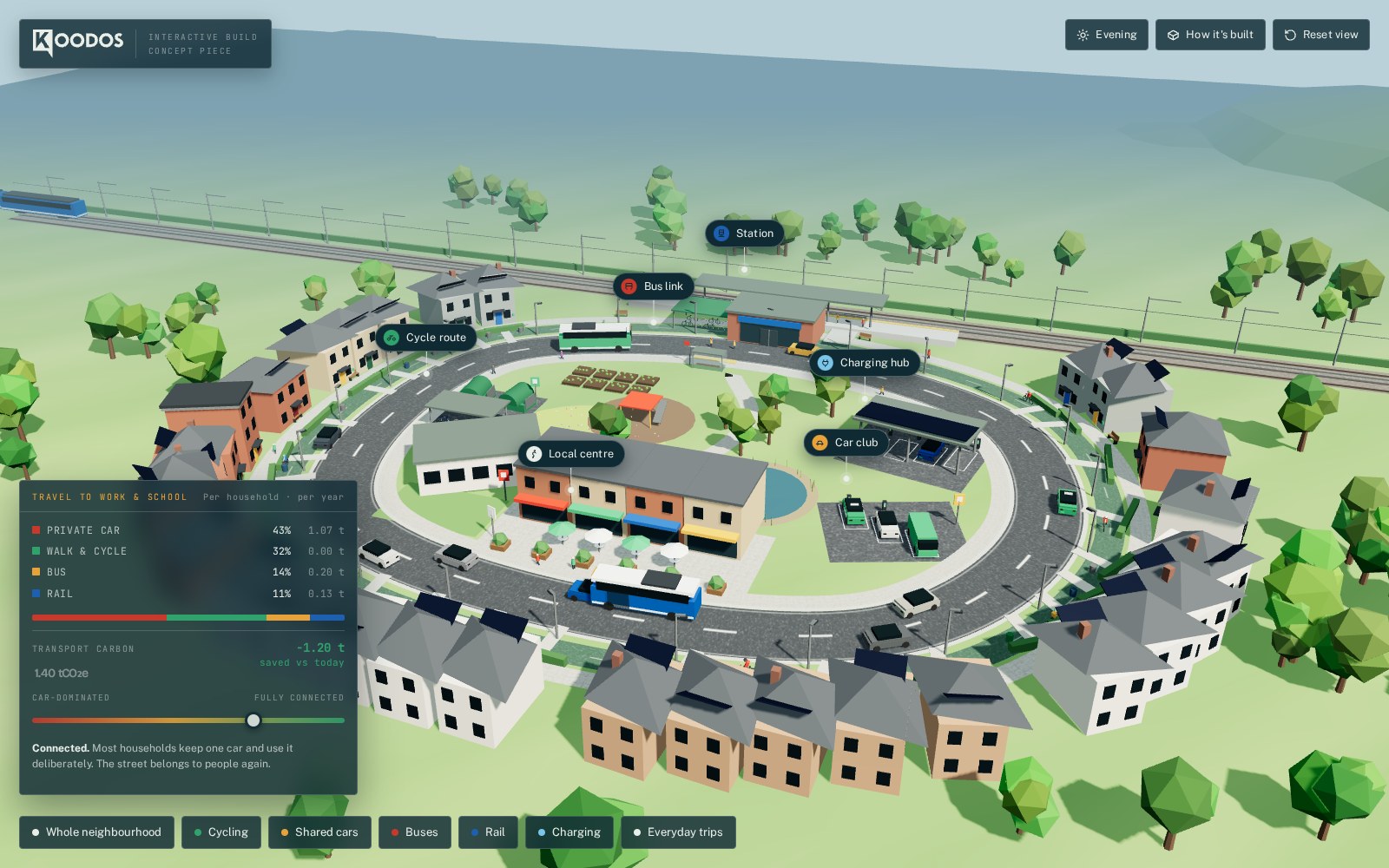
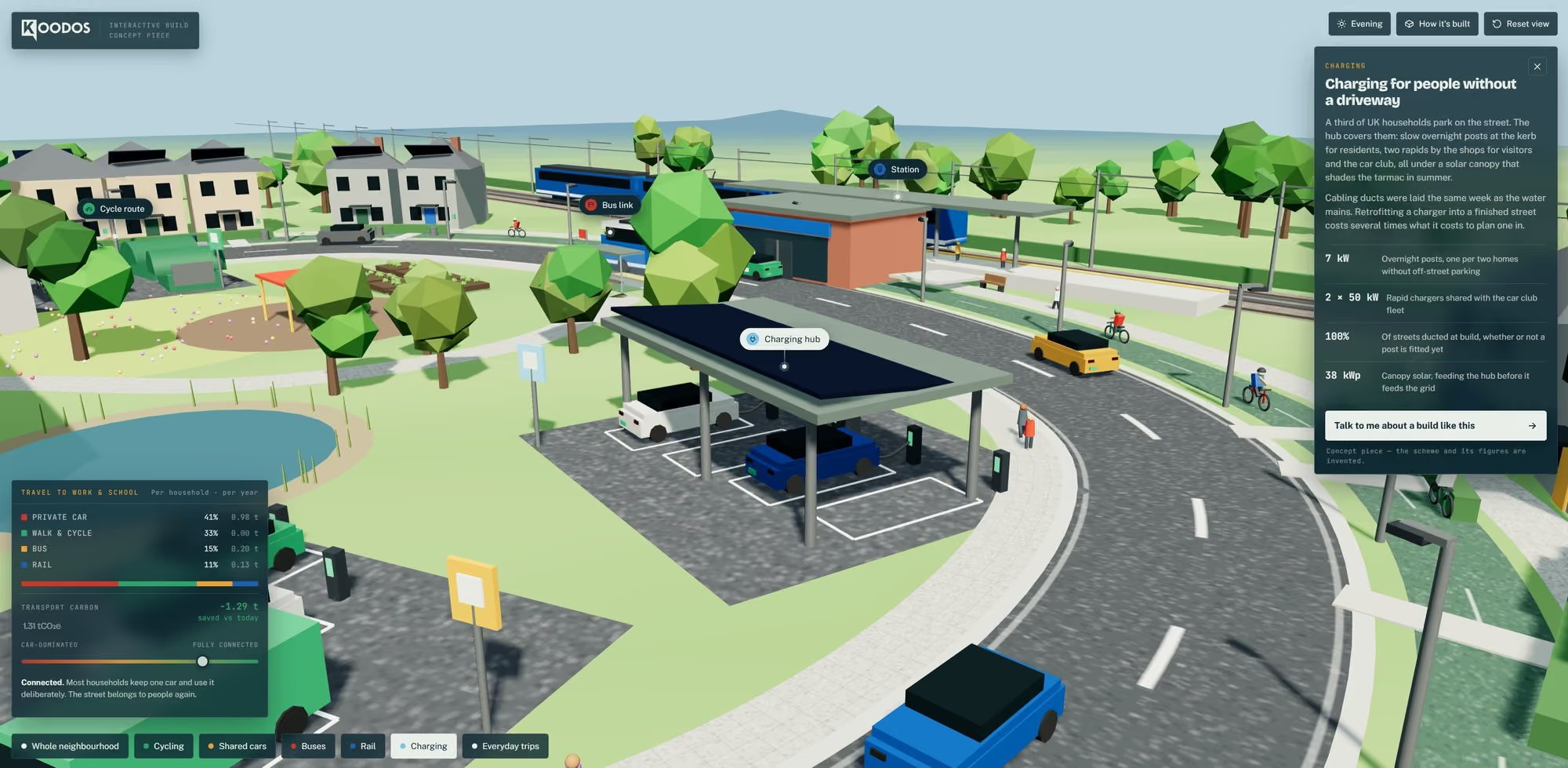
The scene is a small housing development planned around walking, cycling, shared cars, an electric bus link and a railway station. Six points of interest are clickable; the cycle route, the car club, the bus stop, the station, an EV charging hub and the local centre; and each one flies the camera in and opens a short explainer with a few figures.
The centrepiece is a slider labelled "car-dominated" to "fully connected". As you drag it, parked cars and traffic disappear, cyclists and pedestrians appear, a second bus enters service, and a live carbon read-out, styled like a railway departure board which recalculates the household's transport emissions. It's the same argument a brochure would make with a bullet list, except here you can feel it move.
None of the numbers are real, and the demo says so plainly. It's a concept piece built to show a capability, not to represent a delivered scheme.
A year or two ago, a piece like this would have been a proper project. You'd scope it, quote it, and a developer would spend a week or two on the 3D scene alone ( a very generous estimate - coudl be much more) modelling the buildings, wiring up the camera controls, hand-building the interface, testing it across devices. Comfortably into four figures, and that's before anyone argued about the copy.
The cost has collapsed, and it's worth being precise about why, because it isn't simply "AI writes the code now".
The real shift is that the slow, expensive part of a build like this was never the clever 3D maths — libraries have handled that for years. It was the thousand small decisions in between: where the camera should sit for each point of interest, how the slider should feel, what happens on a narrow phone screen, how to keep it all in one file with nothing to break later. That's the work agentic tools now compress. Working alongside an AI coding agent, you spend your time on intent and judgement calls like "the station view is too far back", "the logo needs to sit on a panel or it vanishes at night" etc. and it handles the execution and the fiddly cross-device testing that used to eat the days.
The build genuinely took a few hours across an evening or two, not weeks. But, and this is the whole point, that was only possible because the brief was clear. The AI didn't decide the piece should argue about sustainable travel through a single draggable dial. That decision, the thing that makes it land, came first and came from a person.
For anyone who likes to know what's under the bonnet:
That last point matters a lot. A common trap with generated software is that it works beautifully until something needs changing, and then nobody can read it. Building it to be legible, withcopy and data separated out, no dependency on a subscription staying paid is a deliberate choice, and it's the difference between an asset you own and a black box you rent. Don't subscribe anymore - build and own!
Here's the takeaway I'd want any of my clients to understand.
Interactive, custom-built marketing, the kind that used to be the preserve of firms with a budget for a digital agency (five figure builds) , is now within reach of a one-person business. A configurator, a calculator, an interactive explainer, a product that moves when you touch it: these are no longer weeks of specialist time. They're days, sometimes hours. Ai isnt eating my business, it's opening new opportunities because I can match needs with these new possibilities.
But the cost didn't fall to zero, and it didn't fall evenly. What's become cheap is the execution. What hasn't cheapened; what has, if anything, become more valuable - is knowing what to build and why. The businesses that win here won't be the ones with the best access to AI tools, because everyone has that. They'll be the ones who can look at a vague goal like "make our sustainability credentials feel real" and turn it into a specific, buildable idea like "one dial that rebuilds the street".
Articulate the business need clearly, and the build is now the easy part. That's a genuinely new thing.
The demo lives at showcase-1.getkoodos.com — best on a laptop, but it works on a phone too. Have a drag around, move the dial, and if it sparks an idea for something your own business could use, that's a conversation I'd enjoy having.
The hard part isn't the building any more. It's knowing what's worth building.
Get Your Instant Estimate
Find out your project cost in under 60 seconds.