The Quiet Erosion of the Professional Referral: Why Your Digital Presence could be a Liability
1.2
The Citation Economy: Why Attribution is the New Page One


The Quiet Erosion of the Professional Referral: Why Your Digital Presence could be a Liability
In 2026, a generic website doesn't just look outdated; it is silently leaking your referrals.
Articles in this series
Introduction
Until recently, search success was binary: you either occupied a "blue link" on page one, or you were relatively invisible. However, as we move through 2026, the metric of success has shifted. We have entered the Citation Economy.
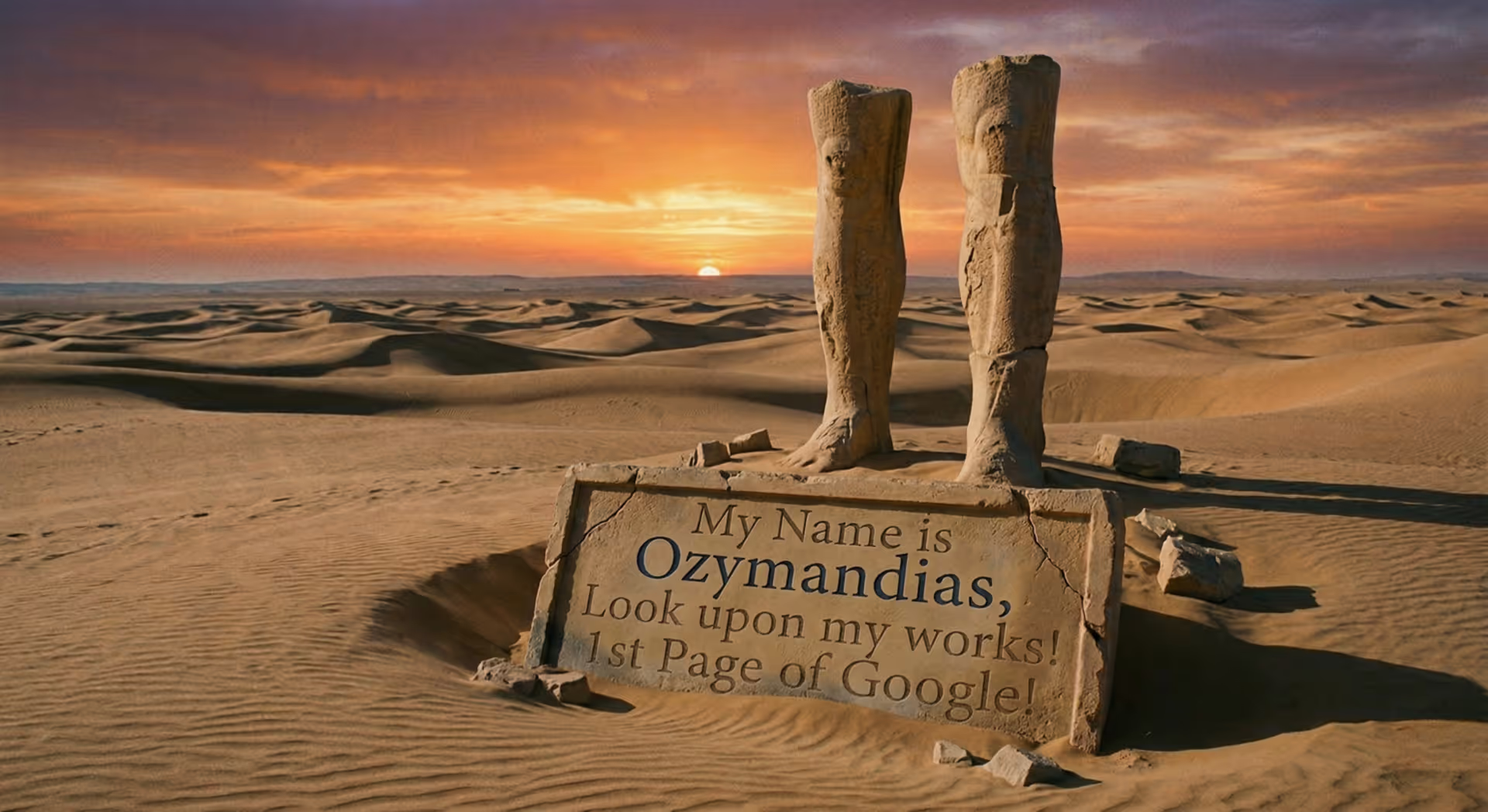
With 59% of searches now resulting in no click, your goal is no longer just to drive traffic to your domain. Instead, you must ensure that when an AI agent synthesizes an answer for a prospect, your brand is the one providing the "ground truth." In this new landscape, attribution is the only reliable form of visibility.
From Keywords to Brand Mentions
One of the most significant shifts in the 2026 algorithm is the decline of the backlink as the primary signal of authority. While links still matter, Google’s AI Mode now places a much higher premium on Brand Mentions across the web.
Data suggests that brand mentions show a correlation coefficient of 0.664 with AI citation probability—substantially higher than the 0.218 seen for traditional backlinks. This means that appearing in industry journals, being quoted in media, and maintaining a consistent presence on third-party platforms (like LinkedIn or YouTube) are now more critical than "gaming" your on-site keywords.

The "Atomic Answer" Framework
To be cited, your content must be "machine-readable." AI models do not read your pages end-to-end; they parse them for extractable "chunks" of truth. To maximize your "Share of Synthesis," we recommend the Atomic Answer framework:
- Direct Headers: Use H2 tags that mirror the specific, complex questions your clients actually ask.
- The 50-Word Summary: Place a concise, factual answer of 40-60 words directly beneath the header. This "Atomic Answer" is easy for AI to ingest and summarize.
- Entity Density: Use the vocabulary of a specialist. AI favors content with high "entity density"— basically this is connecting your core topic to related professional concepts (e.g., linking "Asset Protection" to "Discretionary Trusts" and "Capital Gains mitigation").
Winning the "Grounding" Game
When an AI model generates a response, it undergoes a process called Grounding. It looks for the most trustworthy, stable facts to prevent "hallucinations."
To become the "Grounding" source for your niche, you must prioritize:
- Information Gain: Google’s 2026 updates explicitly reward content that provides new, unique data points or proprietary case studies that cannot be found elsewhere.
- Freshness: Pages updated within the last 30 days are cited at 3.2 times the rate of older content. An Authority Platform is not a "set and forget" project; it is a living repository of your current thinking.
Next in the Series: Solving the Referral Paradox
Now that you have built a Complexity Moat and understood the Citation Economy, how do you tie it all together to stop the "Silent Leak"? In our final article, we look at the Referral Paradox and how to secure the 75% of the buyer journey that happens before they ever pick up the phone.
[Read: Solving the Referral Paradox]
[Return to The Expert's Moat Hub]
Is your brand being mentioned as an authority in the places where AI—and your future clients—are looking for answers?
TL;DR
Clicks are declining as AI provides direct answers. To remain relevant, experts must optimize for 'Citation Velocity' and 'Share of Synthesis'—ensuring their brand is the authoritative source AI is forced to credit.
Mark Thurman


Get Your Instant Estimate
Find out your project cost in under 60 seconds.